
Building Trust Through Traceability
Traceability and transparency are important prerequisites for more sustainability in the cocoa value chain. The members of the Swiss Platform for Sustainable Cocoa are therefore gradually promoting and improving the traceability of cocoa beans back to their origin and disclosing import figures.
What is it about?
Due to the strong globalisation of the food market with many production stages and locations, the traceability of products is not automatically given. Chocolate companies usually purchase the cocoa and intermediate products such as cocoa butter or cocoa paste through several suppliers, who in turn obtain the raw materials from several production sites. Traceability, by contrast, means knowing the origin, the people, the companies and the processing steps behind a product.
Motives for better traceability
Businesses, consumers, civil society organisations and public authorities can all advocate for improved traceability, but with different motivations: For example, to improve supply chain management, to mitigate risks related to safety, quality and sustainability of production, to enable and target direct payments to farmers, to ensure regulatory compliance or to gain consumer trust.
Improved traceability is thus a prerequisite for the targeted management and monitoring of measures to improve sustainability. A high degree of traceability is indispensable particularly for certification as sustainable cocoa and for high-quality cocoa. However, traceability also creates incentives to engage in and report on increased sustainability by increasing transparency and accountability for all actors along the supply chain.
Different levels of traceability
There are different levels of traceability. In the strictest variant, the exact origin and production conditions of the cocoa beans are documented all the way to the end product; in less strict variants, only part of the information is preserved because the cocoa is mixed with other cocoa.
The European Initiatives on Sustainable Cocoa (ISCOs) have agreed on the following four levels:
- Conventional: The cocoa does not meet any traceability requirements. During processing, beans from different production sites are mixed together and the information on the origin and method of production is not documented.
- Mass balance: The cocoa meets the required production standards and the origin and quantity of the cocoa beans is documented at the time of purchase. In later production steps, however, the beans may be mixed with conventional cocoa. Mass balancing also allows cocoa to be sold as certified that technically contains portions of conventional cocoa, as long as the total amount of certified cocoa is not exceeded.
- Segregated: In contrast to the mass-balance-system, the cocoa remains segregated from conventional cocoa during all production steps. However, it may be mixed with same-certified cocoa from other origins.
- Identity preserved: Cocoa from a specific origin remains segregated during all production steps and is not mixed with any other cocoa. This means that the exact information about the origin of the cocoa is preserved until the final product.
Means to create transparency
Transparency is essential to ensure traceability. For certified cocoa, labels such as Fairtrade Max Havelaar and Rainforest Alliance serve as a sign of credibility. Certain companies work with their own sustainability programmes that are verified externally
Digital tools also offer a great opportunity. They allow the entire supply chain to be presented transparently and, above all, the production conditions at origin (the so-called "first mile") to be documented precisely. This allows the respective farmers to be supported in a targeted manner and to be fairly remunerated for their work. Various member projects (see below) therefore aim to use digital tools to establish a direct relationship with the farming families and thus increase their share of the added value.

Traceability means knowing the origin and production method as well as the people behind a product. (Foto ©Chocolats Halba)
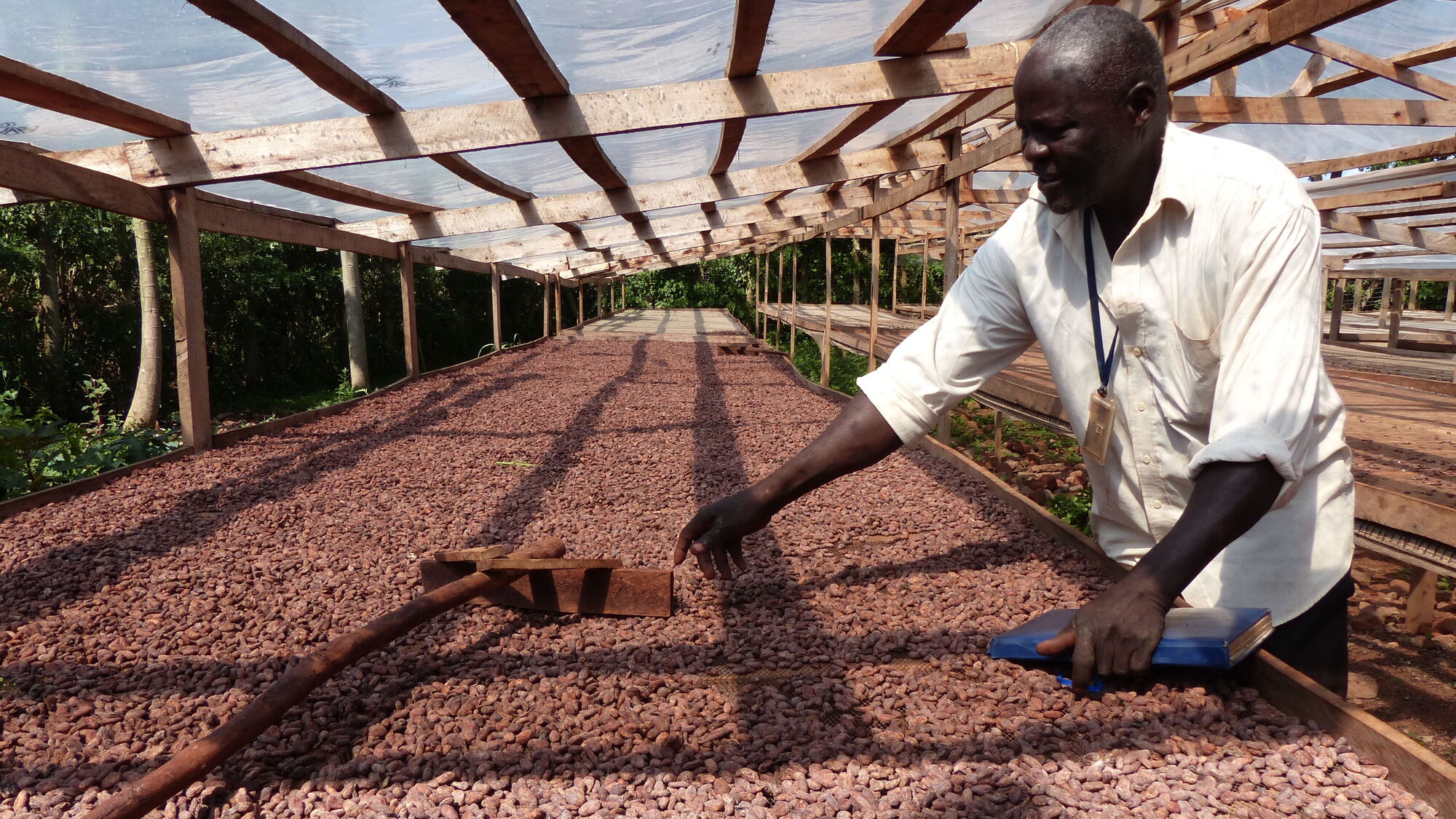
A high degree of traceability is particularly essential for certification as sustainable cocoa and for high-quality cocoa. (Foto ©Swisscontact)
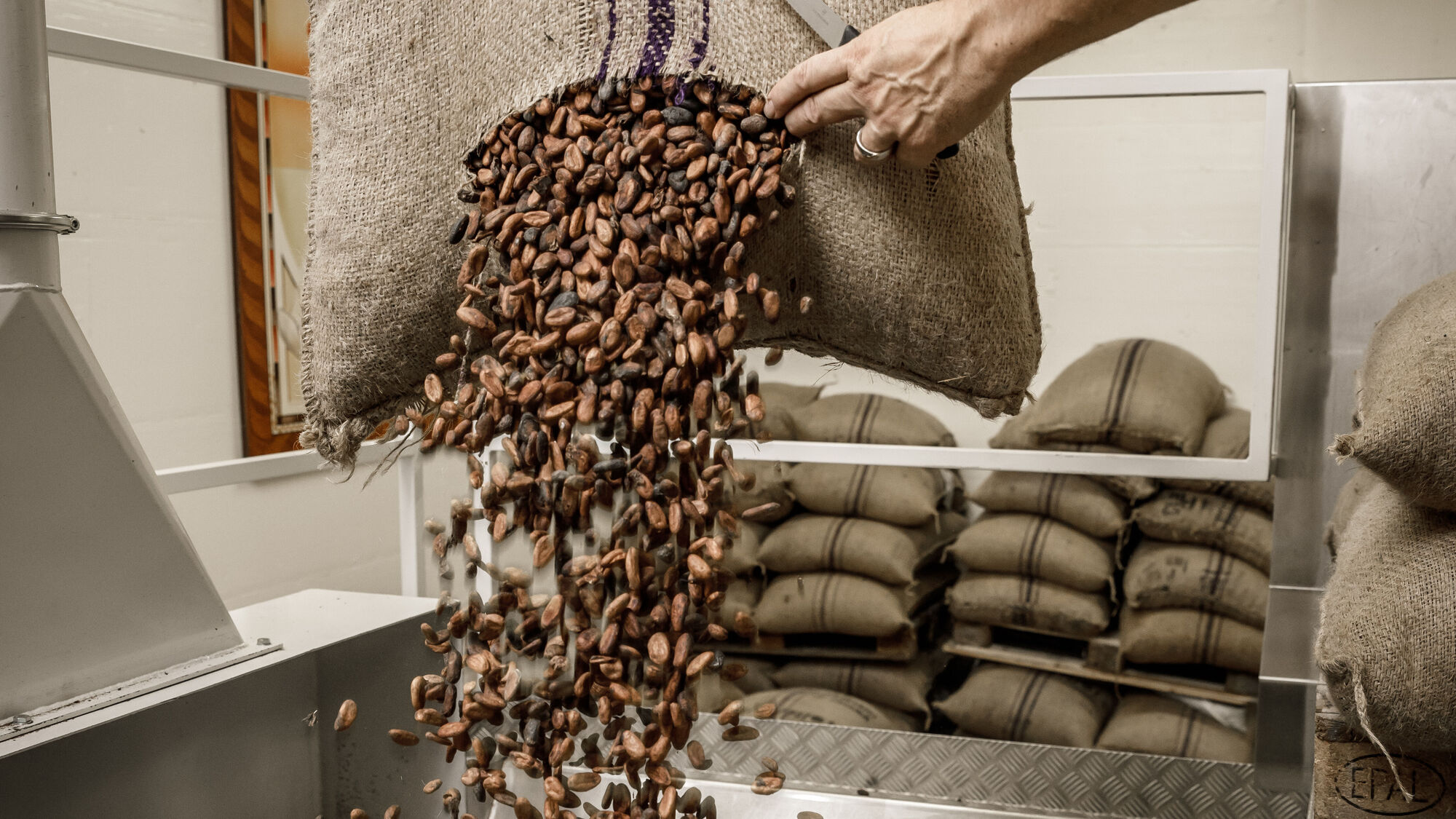
In the strictest form of traceability, cocoa beans from a specific production site remain completely separated from other cocoa during all processing steps into chocolate. (Photo ©Max Felchlin AG)
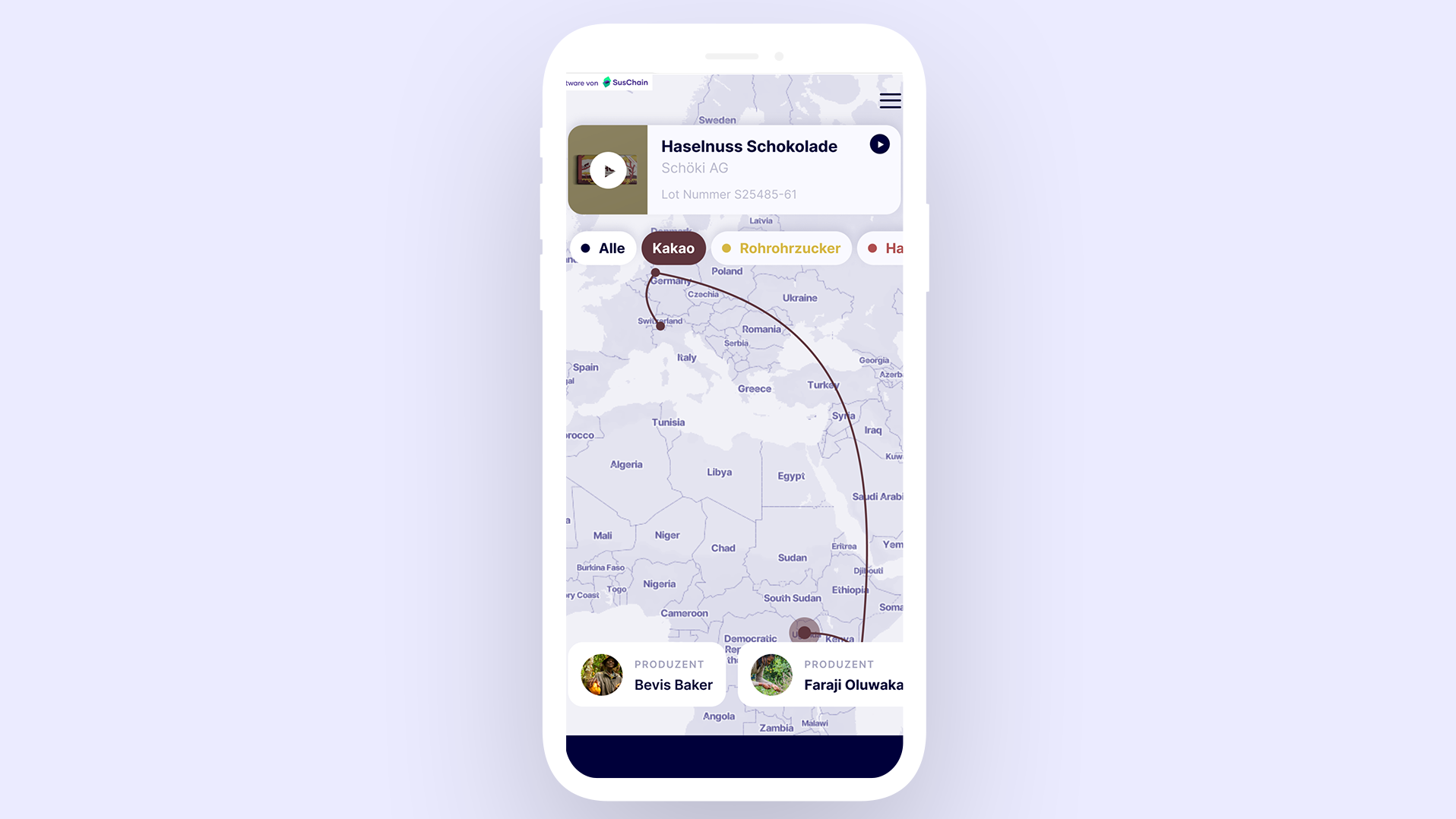
Digital tools such as apps make it easier to show the entire supply chain transparently. (Foto ©Schöki)
The goals of the Cocoa Platform according to the Roadmap 2030
In the area of traceability and transparency, our revised Roadmap 2030 (adopted in June 2025) sets the following ambition:
The physical flow of products containing cocoa to Switzerland relies on fully traceable and transparent supply chains.
To reach this goal by 2030, SWISSCO members commit to:
- Ensuring that all cocoa imports are sourced through credible sustainability schemes that meet defined criteria for independence, verification, monitoring, and transparency.
- Working towards traceability that extends to the first mile, with clear documentation and, where feasible, segregation of physical flows.
- Aligning sourcing schemes with internationally recognised standards such as those that comply with the ISEAL Code of Good Practice.
- Sharing sourcing scheme and assurance information upon request with the SWISSCO Coordination Office.
The Roadmap defines three ambition levels to guide progress, from basic verified sourcing schemes to fully transparent and segregated supply chains using recognised standards.
Our Contribution
To support this ambition, the Swiss Platform for Sustainable Cocoa:
- Collects and publishes annual sourcing statistics for all members.
- Supports SMEs in developing innovative, credible sourcing schemes.
- Offers guidance through peer learning and “Regulation Readiness” workshops.
- Engages in policy dialogue to ensure alignment between private sourcing practices and national policies in producing countries.
This ambition ensures that cocoa products entering Switzerland meet clear sustainability criteria and are traceable from origin to shelf—building trust and accountability across the entire value chain.
Selected projects in the area of traceability and transparency
Various members of the Cocoa Platform are implementing projects for improved traceability and transparency. These projects received a contribution from the State Secretariat for Economic Affairs SECO thanks to the mediation of the Coordination Office.
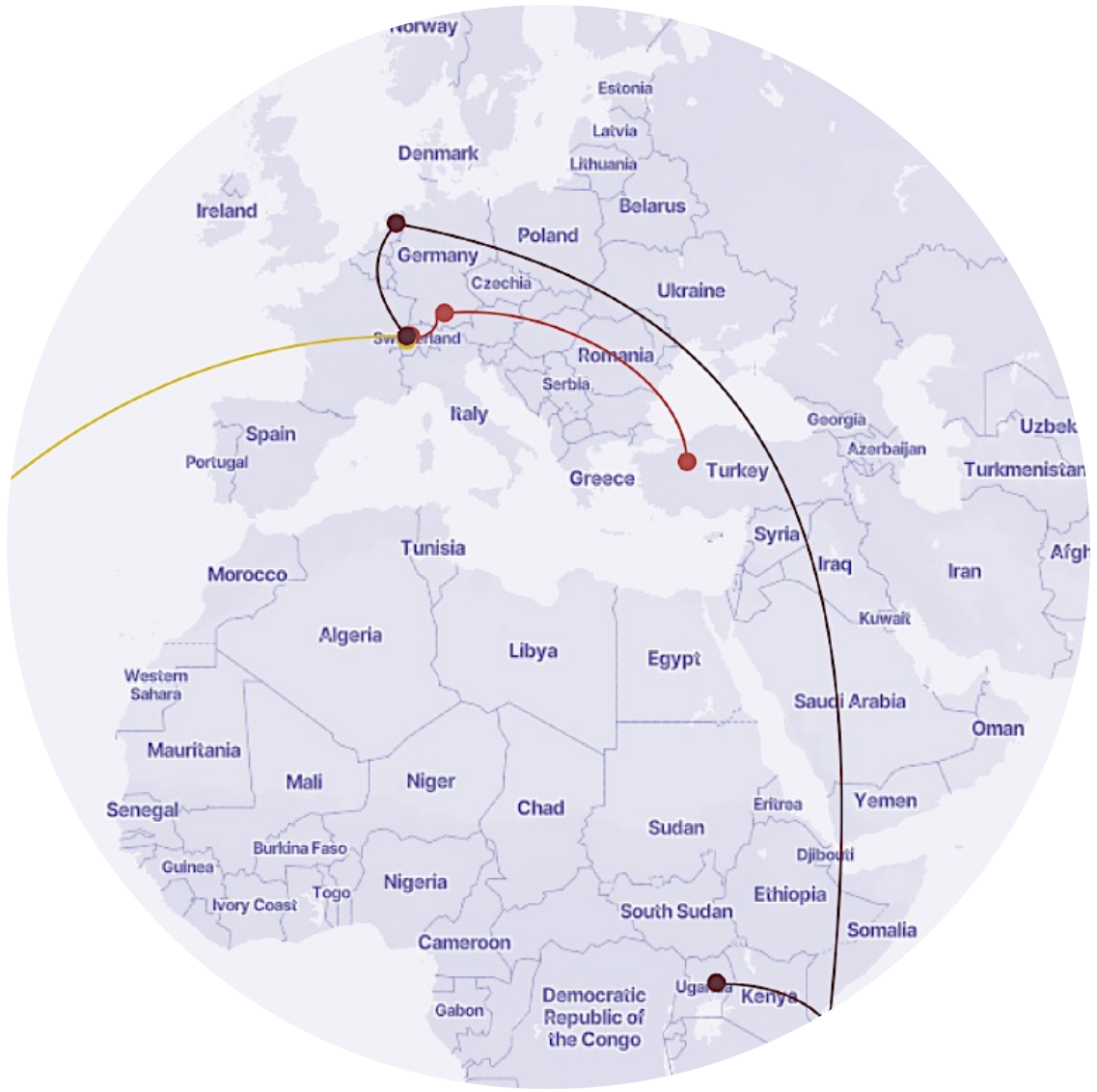
Fair and sustainable chocolate through complete transparency
This project is part of SCHÖKI’s efforts to produce chocolate from cocoa that enables farmers a living income in a sustainable way. SCHÖKI is convinced that fairness and sustainability are possible only through complete transparency along the whole value chain. To achieve this, SCHÖKI initiated the development of an open-source software solution called "SusChain". Learn more about the project

Provide farmers with financial access to healthcare
Each year, more than 100 million people are pushed into extreme poverty because of health-related expenditures, many of them are smallholders in global supply chains. The Akwaaba project ensures access to healthcare for 1,600 cocoa farmers and their families in Ghana, while collecting highly detailed data to monitor its impact on human health, poverty elimination, and child labour. Learn more about the project